FEDMA Position Paper on Digital & AI Omnibus Proposal
The EU risks a deepening competitiveness crisis without swift structural reforms. A new regulatory approach is needed, one that supports digital innovation, economic growth and global competitiveness, rather than focusing predominantly on data‑use restrictions that slow data‑ and AI‑driven progress. The EU must uphold strong data protection while actively enabling economic growth.
FEDMA welcomes the European Commission’s efforts to simplify the digital acquis and the AI Act, particularly for SMEs and small mid‑caps, but stresses that simplification must go beyond reducing compliance burdens. It should meaningfully improve Europe’s capacity to innovate and compete by lowering barriers to growth while maintaining appropriate personal data protection. To achieve this, the EU must move away from a “tick‑the‑box” compliance culture and adopt a more innovation‑friendly regulatory approach, supported by realistic implementation timelines, clear guidance before enforcement and stronger coordination among supervisory authorities. While many of the proposed amendments advance these goals, others still require refinement.
To better achieve the omnibus’ objective, FEDMA proposes:
- Rebalancing more fairly the existing regulatory framework between protecting personal data and stimulating economic growth to more closely align with recital 4 GDPR
- Addressing cookie fatigue by maintaining a technically feasible and a more risk-based version of Art. 88a in the GDPR and repealing Art. 5(3) ePrivacy Directive.
- Avoiding relying on a single, centralised mechanism for automated, machine‑readable user‑choice signals and rather support a market-driven approach and the coexistence of various competing technological solutions developed independently or in collaboration with browser providers, which foster innovation and EU economic growth.
- Ensuring legal certainty through tech-neutral and simple identifiability criteria in the GDPR definition of personal data to support innovation.
- Strengthening global competitiveness through ethical AI development and streamlined GDPR, AI and cybersecurity rules.
- Readjusting the balance to protect businesses from abusive GDPR exploitation (i.e. abusive DSARs) while safeguarding legitimate compensation rights.
- Upholding strong accountability through ROPA obligations to guarantee sustainable growth in data-driven marketing.
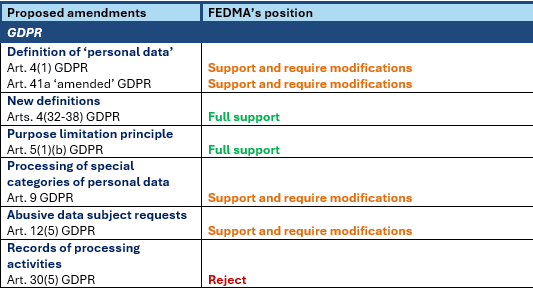
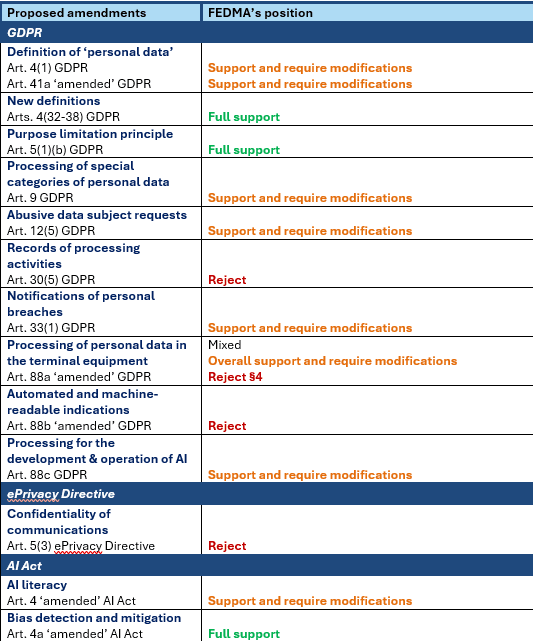
Overview of FEDMA Positions
The beneficial impacts of the above-mentioned proposals will extend beyond the data-driven marketing sector. Personalised digital advertising plays a unique role in the EU economy: 76% of SMEs report that it helps them compete with larger firms and 86% attributing their recent revenue growth directly to its use. Ensuring that regulatory frameworks remain workable and oriented towards economic growth is essential to safeguarding the competitiveness of Europe’s economy and the smaller companies that depend on personalised advertising to innovate and create value across the European Single Market.
More broadly, the digital economy creates unique conditions that allow small and medium-sized enterprises to compete with much larger market players. Through digital tools and data-driven solutions, SMEs can achieve meaningful market reach and performance without the scale of infrastructure, capital, or resources traditionally required. This helps level the playing field, strengthens competition, and supports a more balanced and resilient economic model, one that avoids excessive market concentration and can become a distinctive strength of the European economy in an increasingly centralised global landscape.